What Happens During Factory Acceptance Testing (FAT) Stages 5 - 7
What Happens During Factory Acceptance Testing (FAT) Stages 5 - 7
Stage 5: Surface Finish, Coatings, and Safety
Coatings and Finishes
FAT also includes a review of protective coatings and surface finishes, important for both corrosion resistance and cleanability. Checks include:
● Confirming two coats of chlorinated rubber paint or equivalent on all iron surfaces where specified, especially for bleach and detergent applications.
● Ensuring no paint on any thread surfaces or leveling screws so adjustments remain possible.
● Verifying that brass wearing surfaces on sliders are not being scraped and are correctly aligned.
These guidelines emphasize the importance of appropriate coatings and cleanable surfaces, particularly for food, beverage, and aggressive chemical products. Laub\Hunt’s attention to such details at FAT ensures long‑term durability and sanitation.
Safety Devices and Nameplate
As part of FAT, Laub\Hunt verifies:
● Presence and function of limit switches at the infeed star and on the infeed conveyor.
● Availability and accessibility of grease fittings and other routine‑maintenance points.
● Correct, legible nameplate data (model, serial, ratings), which customers will use for documentation and future parts orders.
Best practices call for safety verification (guards, interlocks, e‑stops) and accurate identification plates as prerequisites for shipment. Laub\Hunt incorporates these checks to help customers meet safety and compliance requirements.
Stage 6: Long‑Run Performance Trials
Extended Run Test
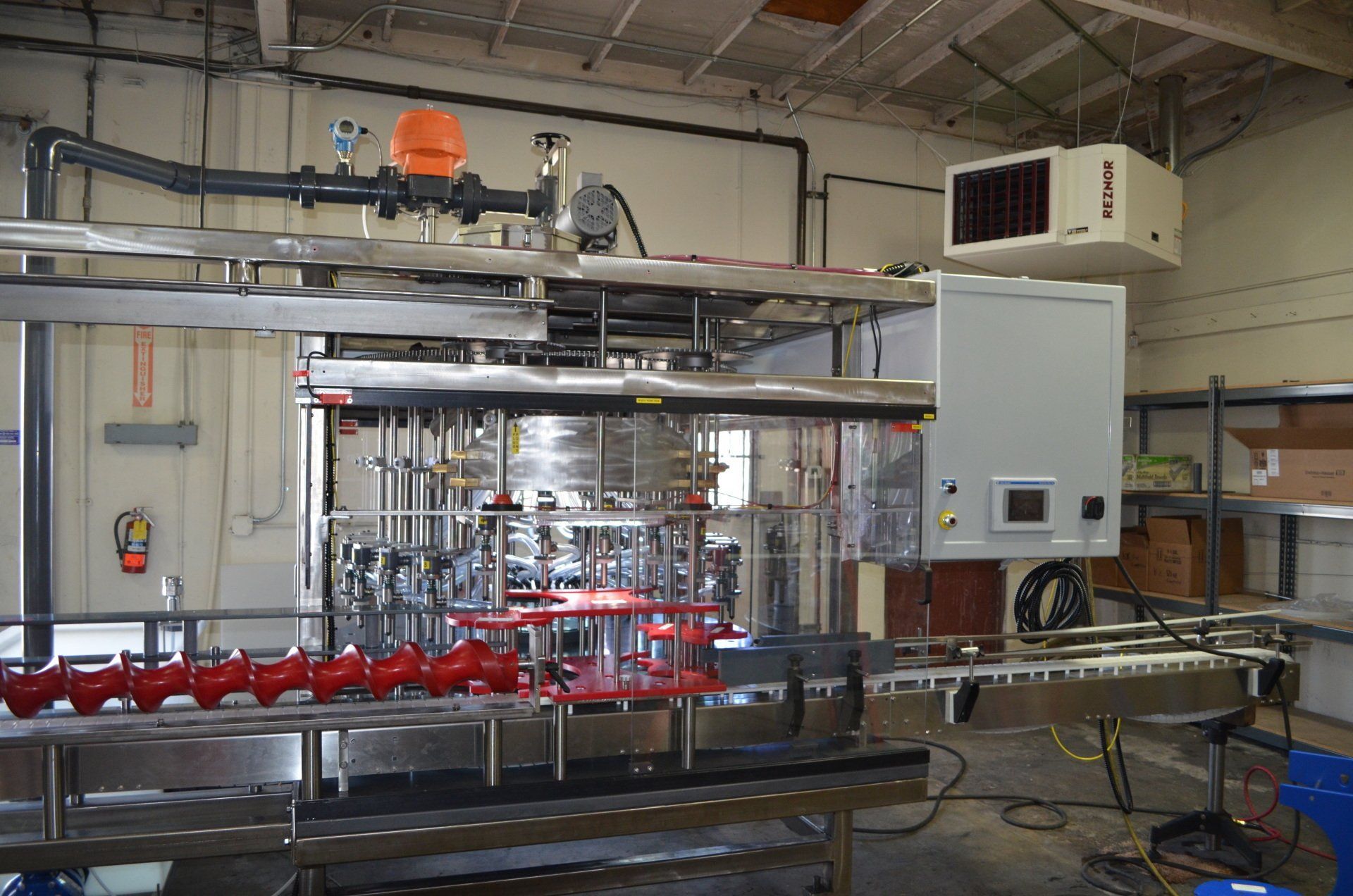
FAT is not limited to quick spot checks. Laub\Hunt performs extended run tests where the machine operates for a couple of hours at or near production speeds with water and bottles. During this period, technicians evaluate:
● What wears: observing cams, followers, sliders, and seals for abnormal heat, friction, or polish.
● What rubs or squeaks: diagnosing any contact or misalignment indicated by noise.
● Smooth transfer of bottles across bridge plates, transfer plates, donut plates, and conveyor chains, ensuring no stumbling or misfeeds.
Longer‑duration FAT runs are essential for revealing latent issues that short trials miss—such as thermal growth, creeping misalignment, or intermittent jams. Laub\Hunt’s long‑run tests follow that logic and are documented as part of the FAT record.
Torque Limiter and Overload Behavior
Laub\Hunt’s checklist also calls for verifying the torque limiter: It must be adjustable so the machine can be pulled back while running and restarted from any position. During FAT, Laub\Hunt:
● Tests overload conditions to ensure the torque limiter slips or releases as designed.
● Confirms that the machine can resume operation without binding after an overload event.
Tests of overload and emergency behavior ensures both equipment protection and operator safety. Including this in FAT means customers receive a machine whose protective systems have already been proven under controlled conditions.
Stage 7: Special Tests for Detergent and Chemical Applications
Suds and Chemical‑Behavior Tests
For fillers intended for bleach, detergents, and other foaming or chemically aggressive products, Laub\Hunt performs specialized tests beyond standard water trials. These include:
● “Suds tests” using detergent or ammonia solutions to observe foam behavior in the bowl, valves, and overflow paths.
● Checks that level controls remain stable and that foam does not cause chronic false readings or spills.
● Validation that seals, coatings, and materials in contact with test solutions behave as designed.
It is necessary to test performance under realistic process conditions, including foaming and temperature variations, before shipment. Laub\Hunt’s suds and chemical‑behavior tests are the result of decades’ experience in the bleach and household‑chemical markets.
Stage 8: Spares, Accessories, and Documentation
Counting Stars, Guides, and Spares
A comprehensive FAT also ensures that everything promised in equipment order is present and accounted for. Laub\Hunt technicians:
● Count and record the number of stars and guides shipped.
● Verify the number of spare valves and confirm they are fully assembled and ready to use.
● Confirm that a grease gun and a tube of Parker O‑Lube (or equivalent) are packed with the filler.
Best practices include checks that all auxiliary equipment, tools, and documentation are present, as these items are often critical to smooth commissioning.
Final Documents and FAT Report
Throughout the FAT, Laub\Hunt records:
● Test results, observations, and any deviations from expected performance.
● Adjustments made and final “zero settings” (e.g., fill volumes, speeds, and key alignment points).
● Outstanding minor items, if any, with a plan for resolution.
Best practices call for a formal FAT report and acceptance certificate once criteria are met, with any minor punch‑list items documented separately. Laub\Hunt follows this model, ensuring that you have a shared, written record of what was tested and accepted before shipment.
What FAT Means for You
When Factory Acceptance Testing is complete, you receive a filler that has already:
● Been fully lubricated, aligned, and checked for mechanical integrity.
● Passed dry and wet functional checks, including leak tests, safety verifications, and extended runs.
● Demonstrated performance with your bottles under realistic conditions.
● Had its accessories, spares, and documentation verified and packed.
Industry standards—and Laub\Hunt’s decades in liquid filling—show that this investment in the FAT dramatically reduces startup time, rework, and risk at your plant. By the time your machine reaches your dock, the heavy troubleshooting has already been done, allowing installation and commissioning to focus on integration and optimization rather than basic fixes.
Contact us for more information. Also review
stages 1-2 and
stages 3-4.