How Laub\Hunt Packaging Systems Builds a Liquid Filling Machine – Part 2
How Laub/Hunt Packaging Systems Builds a Liquid Filling Machine – Part 2
Engineering the Fill Method
The fill method is the heart of the machine. Laub/Hunt chooses among MAGFlow, MASSFlow, Pressure Metering, Piston Posi-Filler, Gravity, Pressure Gravity, Pressure, and Vacuum depending on whether the product must prioritize speed, visual fill consistency, volumetric precision, or handling of difficult fluids.
This matters because bleach and many industrial chemicals may favor chemical-resistant, overflow, or volumetric designs, while food sauces, lotions, or creams may need piston or positive-displacement systems. In practice, engineers test fill accuracy, drip behavior, foaming, and container compatibility before freezing the final design.
Materials and Safety
Material selection is critical because the wrong alloys or polymers can fail under corrosive or aggressive products. Laub\Hunt uses stainless steel for sanitary systems and HDPE or other corrosion-resistant materials for harsh chemical applications, with explosion-proof or hazardous-location options when needed.
This is especially important for bleach, solvents, acids, automotive fluids, and industrial cleaners, where the machine must resist chemical attack while protecting operators and the plant environment. A well-designed machine also includes guarding, drip management, emergency stops, and control logic that supports safe operation and maintenance.
Controls and Automation
Modern filler manufacturers build the machine around a control system that manages fill time, volume, speed, indexing, and fault detection. Manual and semi-automatic systems are still useful for smaller runs, but many customers want fully automatic equipment that integrates with upstream and downstream packaging equipment.
Typical automation features include PLC control, adjustable fill timers, individual head adjustment, and quick changeover settings for different bottle sizes or products. Automation is especially valuable because it supports repeatability across many product categories and helps customers scale production without rebuilding the whole line.
Build and Assembly Process
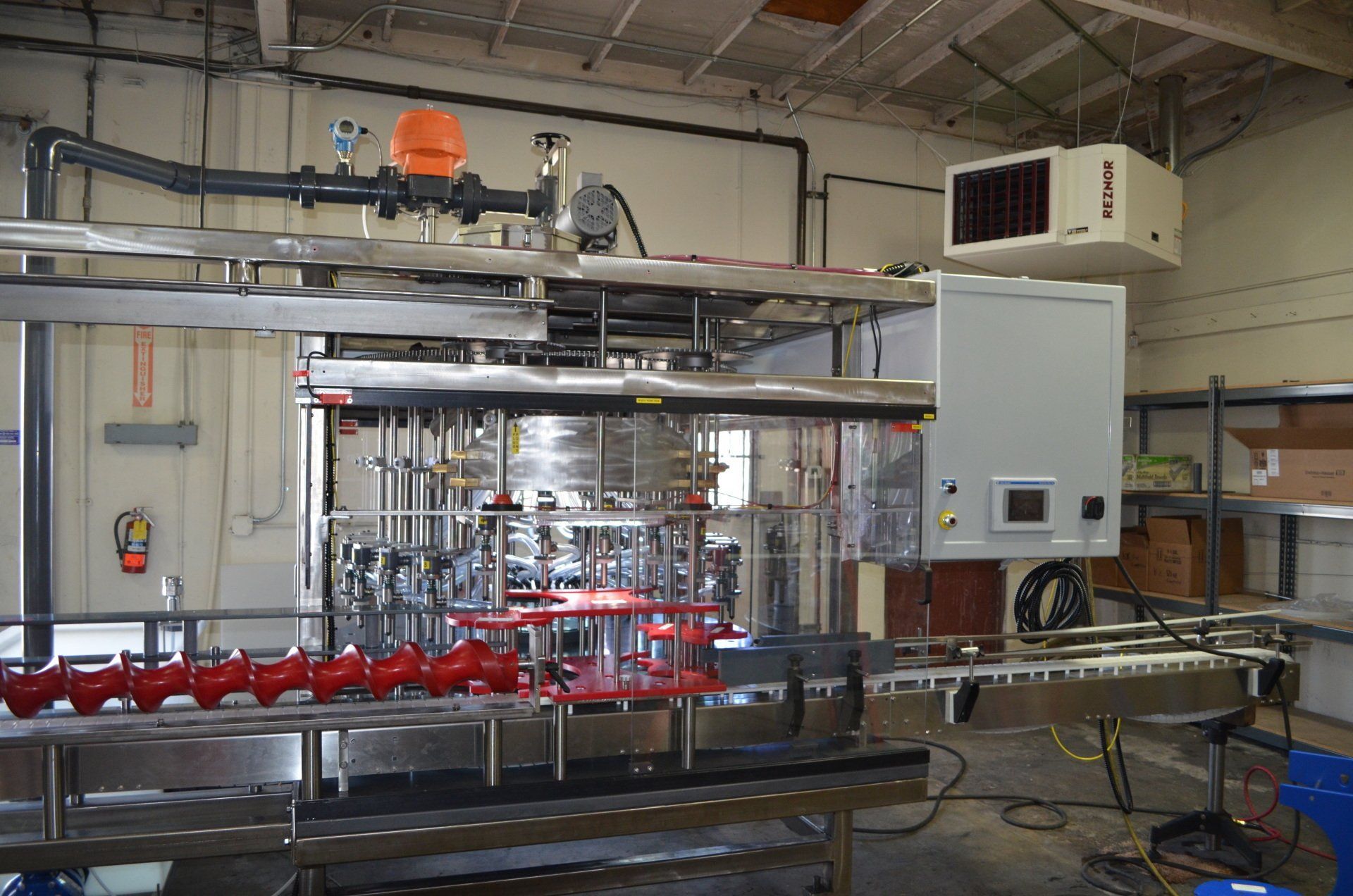
A typical build begins with requirements gathering, then moves to mechanical design, electrical design, fabrication, assembly, testing, and installation support. Laub/Hunt customizes the machine to the customer’s container type, target throughput, fill accuracy, and sanitation or hazardous-area requirements.
During assembly, technicians mount the frame, install pumps or cylinders, route tubing and wiring, add nozzles and sensors, and calibrate the controls. Before shipment, the machine is tested with product or simulants to verify dose accuracy, repeatability, line speed, and maintenance access.
Quality and Validation
Quality assurance is where the machine becomes a dependable production tool rather than just assembled hardware. Laub\Hunt verifies that the filler meets specification for accuracy, repeatability, cleanliness, and uptime, especially when the equipment serves regulated or high-value products.
Testing typically includes cycle checks, leak checks, nozzle behavior, container handling, and product-specific trials for foaming or viscous materials. For Laub/Hunt, this validation step is an important point in the manufacturing process because customers in food, personal care, and chemicals expect the machine to run consistently from day one.
Laub\Hunt Packaging Systems
Laub\Hunt can tailor one platform to many liquid categories while maintaining the engineering discipline around each product’s risks and handling needs. Its machine portfolio emphasizes modularity, sanitary options, corrosion resistance, hazardous-location capability, and multiple dosing technologies.
The best liquid filling machine is not one universal design, but a family of engineered solutions matched to product chemistry, container geometry, and production goals. This is important for customers serving the Bleach, Pool/Spa, Food & Beverage, Industrial Chemicals, Household Products, Personal Care, and Automotive industries.
Key Takeaways
- A liquid filling machine is built around the product first, not the hardware, so viscosity, foaming, corrosion risk, and sanitation needs determine the design.
- The fill method is the core engineering choice, with gravity, overflow, piston, and volumetric systems each serving different product types and accuracy goals.
- Material selection matters as much as the mechanics, especially for bleach, pool/spa chemicals, industrial cleaners, and other caustic liquids that require corrosion-resistant construction.
- Automation and controls make the machine reliable and scalable, helping manufacturers maintain fill accuracy, reduce waste, and support faster changeovers across different containers and products.
- Modularity is important: One platform should be able to adapt to multiple product lines offering sanitary, chemical-resistant, or hazardous-duty options.
Contact us for more information, see part 1 and part 3 of this series.