15 Quality Assurance Checks: Safety, Durability, and Final Sign-Off - Part 2
The 15 Quality Assurance Checks Every Machine Must Pass Before Shipment
7. Detergent / Suds Test for Harsh Products
For bleach, detergents, and other foaming or chemically aggressive products, a dedicated suds test is performed to simulate actual operating conditions. The internal checklist specifically calls for a “Suds Test for detergent, ammonia.”
In this QA check, a technician:
● Runs the machine with a detergent or representative foaming solution under controlled conditions.
● Observes foam behavior in the bowl, valves, and discharge to ensure reliable operation and level control.
● Assesses material compatibility and surface finishes, looking for early signs of corrosion or staining in exposed iron or steel.
● Confirms that return and overflow paths can handle foam without flooding or loss of level control.
As a manufacturer of bleach and detergent filling machinery, Laub\Hunt uses corrosion‑resistant materials, coatings, and seal designs, and they typically validate performance under realistic chemical loads before release. Laub\Hunt’s suds test ensures that machines intended for these harsh applications are evaluated under representative conditions.
8. Conveyor and Bottle Handling Performance
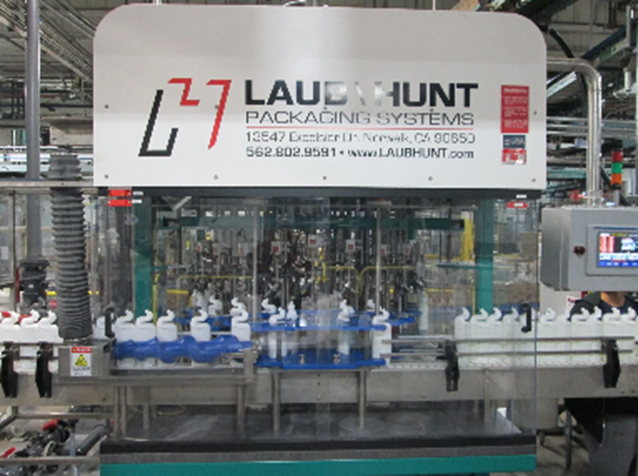
Reliable line performance depends on more than the filler itself; the conveyor system and its interfaces are critical. The checklist includes items on conveyor gearbox oil, ball bearings, wear strips, transfer plates, skidding adequacy, and the presence of switches on the infeed conveyor.
In this QA check:
● Conveyor gearbox lubrication and bearing condition are confirmed.
● Wear strips are inspected, and washers under holding bolts are checked to ensure smooth bottle travel.
● Transfer plates between conveyor and donut plate or stars are tested with bottles to eliminate stumbling, tipping, or gaps.
● Skidding and transport provisions are reviewed with carriers to ensure the machine and conveyor sections are adequately supported in transit.
● Presence and basic operation of conveyor infeed switches and sensors are verified.
Laub\Hunt treats the conveyor interface as a critical part of their FAT, running customer bottles to identify interaction issues early and documenting recommended speeds and accumulation conditions. This step ensures that bottles are handled gently and predictably from the first day of installation.
9. Safety Features and Interlocks
Safety engineering has advanced significantly, and Laub\Hunt’s pre‑shipment checks integrate both legacy safeguards and modern safety expectations. The checklist references a limit switch at the infeed star and a switch on the infeed conveyor, both key elements of jam detection and line control.
This QA check covers:
● Verification that all limit switches, safety interlocks, and e‑stop circuits are installed and functional.
● Functional testing of infeed star and conveyor switches to ensure the machine responds correctly to starved or jammed conditions.
● Confirmation that guarding provisions, access doors, and interlocked panels meet current customer and regional requirements.
Current safety standards outline formal risk assessment and safeguarding requirements for packaging machinery, including guarding of pinch points and moving parts. OSHA’s general machine guarding standard also reinforces the need to protect operators from rotating parts and nip points on packaging machines. By checking safety devices at the factory, Laub\Hunt supports faster compliance verification on site.
10. Surface Finish, Coatings, and Sanitary Design
Surface condition and coatings have a direct impact on corrosion resistance, cleanability, and operator safety. Laub\Hunt’s checklist specifies two coats of chlorinated rubber on all iron surfaces, no paint on thread surfaces, and rounding bumpable corners to a 1/8 in radius so they will not injure anyone.
In this QA check:
● Painted and coated surfaces are inspected for full coverage, adhesion, and absence of runs or bare spots.
● Threads and precision mounting surfaces are checked to ensure they are free of paint or coating that could interfere with assembly.
● Edges and corners in operator reach zones are ground round to at least a 1/8 in radius to reduce injury risk.
● Brass wearing surfaces on sliders are examined to ensure they are not being scraped or gouged.
Hygienic design guidelines for food and beverage equipment emphasize smooth, cleanable surfaces and avoidance of sharp edges in contact and non‑contact zones alike. Corrosion‑resistant coatings on iron and steel components are also widely used in detergent and bleach filling applications to extend equipment life.
11. Control System and Functional Logic Testing
Beyond the physical hardware, the control system must execute the correct sequence of operations. Laub\Hunt’s checklist calls for checking float switch travel (at least 4 in. between on / off), verifying plunger operation with a full tank, and ensuring correct wiring of solenoid valves.
This QA check includes:
● Verifying float switch hysteresis and travel to maintain stable tank levels.
● Confirming pressure regulator settings that govern plunger motion, valve actuation, and puffing cycles.
● Testing the timing and sequencing of infeed, starwheel, valve open/close, and outfeed functions under no‑load and load conditions.
● Documenting key control parameters as shipped, so customers can reference factory settings during commissioning.
Laub\Hunt’s FAT protocols for high‑speed filling lines dedicate substantial time to control logic verification, simulating jams, bottle absence, and other fault conditions to ensure safe and predictable response. Its Controls QA check is designed to deliver a predictable baseline that reduces on‑site debugging.
12. Long‑Run Reliability and Wear Observation
A brief dry run is not enough to reveal wear or rubbing issues. Laub\Hunt’s checklist calls for running the machine at least two hours and specifically watching for what wears, rubs, and squeaks.
In this QA check:
● The machine is run for an extended period at representative speeds with bottles and water.
● Technicians periodically inspect cams, followers, sliders, stars, guides, and conveyors for unusual wear patterns or heat.
● Audible monitoring is used to detect squeaks or rubbing that indicate misalignment or improper lubrication.
● Any issues are corrected and re‑tested before the machine is released for shipment.
Laub\Hunt integrates extended trial runs into FAT to validate component life, verify torque limiter settings, and observe thermal stability at full speed. This long‑run check is a key reason why customers can install and start up Laub\Hunt equipment with minimal early‑life troubleshooting.
13. Torque Limiter and Overload Protection Testing
Torque limiters protect both the machine and product flow when jams occur. The internal checklist specifies verifying that the torque limiter can be adjusted so the machine can be pulled back while running yet will restart from any position.
This QA check:
● Confirms the torque limiter is installed, correctly oriented, and accessible for adjustment.
● Tests overload behavior by simulating a mild jam and verifying that the drive slips or releases as intended.
● Validates that the machine can be restarted from any position after an overload event without binding.
Risk‑based safety standards for packaging machinery encourage the use of torque‑limiting and overload‑protection devices to reduce injury risk and mechanical damage during foreseeable misuse and jams. Laub\Hunt explicitly validates this functionality before shipment to ensure the protection is active from day one.
14. Documentation, Spares, and Accessory Verification
A well‑built machine must be accompanied by complete documentation and the right accessory package. The checklist calls out the number of stars, guides, spare valves, the presence of a grease gun, and a tube of Parker O‑Lube packed with the filler, as well as a nameplate.
This QA check covers:
● Counting and recording stars and guides shipped, including any dedicated change parts.
● Confirming the number of spare valves and ensuring they are fully assembled with appropriate seals.
● Packing the specified grease gun, lubricant tubes, and any special tools required for routine maintenance.
● Verifying the machine nameplate information (model, serial, ratings) is correct and readable.
● Ensuring that installation, operation, and maintenance documentation is included in the shipment.
Factory acceptance practices at major OEMs increasingly link spare parts lists and lubrication charts directly to equipment serial numbers, often via digital platforms or QR codes, to simplify lifecycle support. Laub\Hunt’s documentation and spares QA check aligns with this trend to support faster maintenance adoption in the field.
15. Final Pre‑Shipment Audit and FAT Sign‑Off
The final QA check is a structured pre‑shipment audit. At this stage, all prior checks are reviewed, any open items are closed, and the machine is evaluated against customer specifications and applicable standards.
This check includes:
● Reviewing and signing off on all lubrication, mechanical, alignment, leak, safety, and functional test records.
● Confirming that skidding and packaging arrangements are adequate for transport.
● Capturing key test data (speeds, fill volumes with water, changeover times, etc.) to support the customer’s own site‑acceptance testing (SAT).
● Ensuring alignment with current safety and hygiene guidance for the intended industry segment (household chemicals, food, beverage, or other), informed by sources such as compliance guidelines, OSHA requirements, and hygienic design guidelines.
Leading global packaging machine suppliers use structured FAT processes as a contractual milestone, often witnessed by the customer, to verify that the equipment meets performance and safety requirements before shipment. Laub\Hunt’s final pre‑shipment audit formalizes this into a repeatable, document‑backed process.
How These 15 Checks Benefit Your Operation
By formalizing our 15 QA checks and aligning them with modern industry practices, Laub\Hunt ensures machines:
● Arrive mechanically sound, lubricated, and aligned.
● Start up faster, with leak‑free product paths and proven controls.
● Operate safely, with validated interlocks, torque limiters, and rounded, guarded interfaces.
● Withstand the demands of harsh chemistries and sanitary environments.
For customers, this means less time debugging on site, fewer surprises after installation, and a more predictable path from delivery to full production.
Key Takeaways
● Every machine undergoes 15 structured QA checks covering lubrication, mechanics, alignment, controls, safety, and performance.
● Pre‑shipment validation reduces installation time and minimizes on‑site troubleshooting.
● Wet testing and product‑simulation testing (including detergents) ensure leak‑free, real‑world readiness.
● Alignment and bottle‑handling checks protect against jams, breakage, and inconsistent fills.
● Safety systems, interlocks, and torque limiters are verified before shipment to support compliance and operator protection.
● Long‑run testing identifies early wear, noise, or heat issues that short tests miss.
● Documentation, spares, and setup parameters are delivered complete to accelerate commissioning and maintenance.
● The final audit and FAT sign‑off create a documented, repeatable standard aligned with modern industry expectations.
You can also review Part 1 of this series. Part 3 coming soon. Contact us for more information.