Selecting the Right Liquid Filling Machine – Part 1
Selecting the Right Liquid Filling Machine – Part 1
Laub\Hunt Packaging System’s
filling platforms span a broad range of liquid behaviors, container types, and production goals. The right machine depends less on the label of the technology and more on product viscosity, foaming, conductivity, container style, line speed, and the level of fill precision required.
Executive Summary
Liquid filling systems generally fall into two broad families: rotary and inline. Rotary systems prioritize high speed and compact footprints, while inline systems typically offer lower capital cost, easier expansion, and greater flexibility for smaller or more variable production runs.
Across both families, the filling method matters as much as the machine format. Volume-based, level-based, pressure-based, vacuum-based, and flow-meter-based systems each solve different product challenges, from thin foaming liquids to thick viscous products and high-value formulations that demand tighter accuracy.
Machine Families
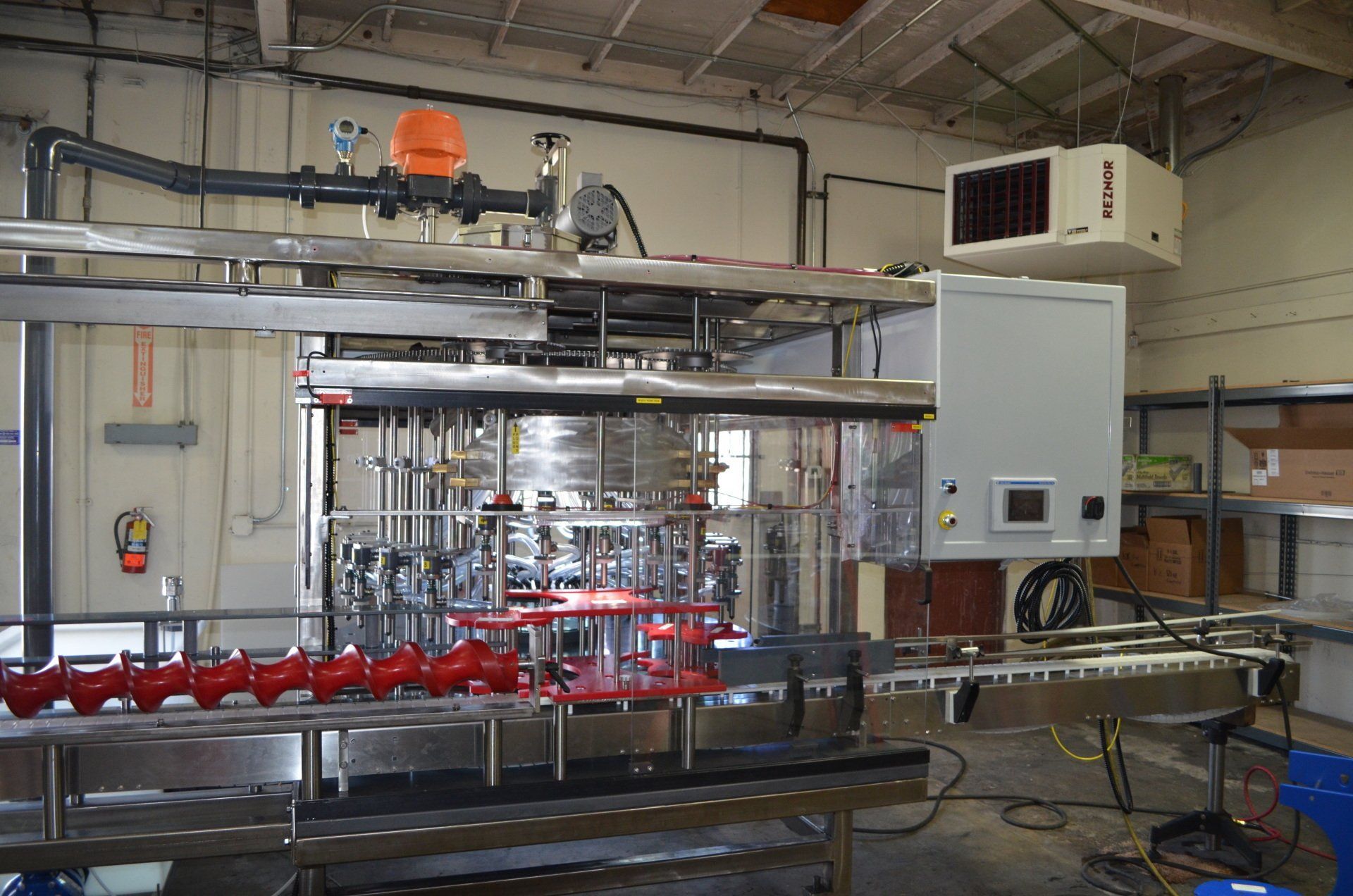
Rotary fillers use a circular indexing carousel to move containers through filling stations, making them a strong choice for high-output production in compact space. They are commonly used where speed, efficiency, and integration with capping are priorities.
Inline fillers move containers in a straight line and are often preferred for lower-to-moderate speeds, frequent changeovers, or applications where modular expansion is important. Inline systems are commonly available as pump, flowmeter, overflow, and monobloc-capable configurations.
Filling Methods
Volumetric filling dispenses a preset amount of product rather than filling to a visible level. This approach is widely used because it stays accurate across different container shapes and works well for many liquid types, including medium-viscosity products.
MAGFlow refers to electromagnetic flow-meter filling. It is best suited to conductive liquids that do not contain oils, and it is valued for hygienic, repeatable, high-speed operation.
MASSFlow refers to Coriolis mass flow-meter filling. It is well suited to non-conductive and high-value liquids where very high accuracy is important.
Pressure Metering systems combine controlled pressure with metered delivery to improve fill consistency, especially for thicker or more demanding products. In practice, these systems are often used where the product must be pushed reliably through the line while maintaining repeatable output.
Piston fillers draw products into a cylinder and then push it into the container. They are a strong choice for thick, viscous products such as creams, lotions, pastes, and similar materials.
Fill-to-a-Level / Overflow fillers do not target a fixed volume; they target a consistent visible fill height. That makes them ideal for clear containers, premium shelf presentation, and products that foam during filling.
Gravity fillers rely on product flow from an elevated tank into the container. They are simple, economical, and best for low-viscosity liquids such as water-like products.
Pressure Gravity fillers can operate in either pressure or gravity mode, giving flexibility for free-flowing products and foamy liquids across multiple container types. This style is especially useful on lines that handle several product families.
Pressure fillers use positive pressure to move product into the container and are commonly favored for carbonated or foamy products and for applications needing faster, more controlled delivery than gravity alone can provide.
Vacuum fillers use suction to fill containers and are typically chosen when gentle handling or specific container/closure conditions make vacuum transfer useful. They are less universal than gravity or piston systems but still important in certain niche applications.
Monobloc Filler-Capper machines combine filling and capping on one integrated frame. They reduce floor space, improve line efficiency, and are especially useful where synchronized filling and closure application matter.
See part 2 and part 3 of this series. Contact us for more information.